What I learned while preparing for interviews in 2026
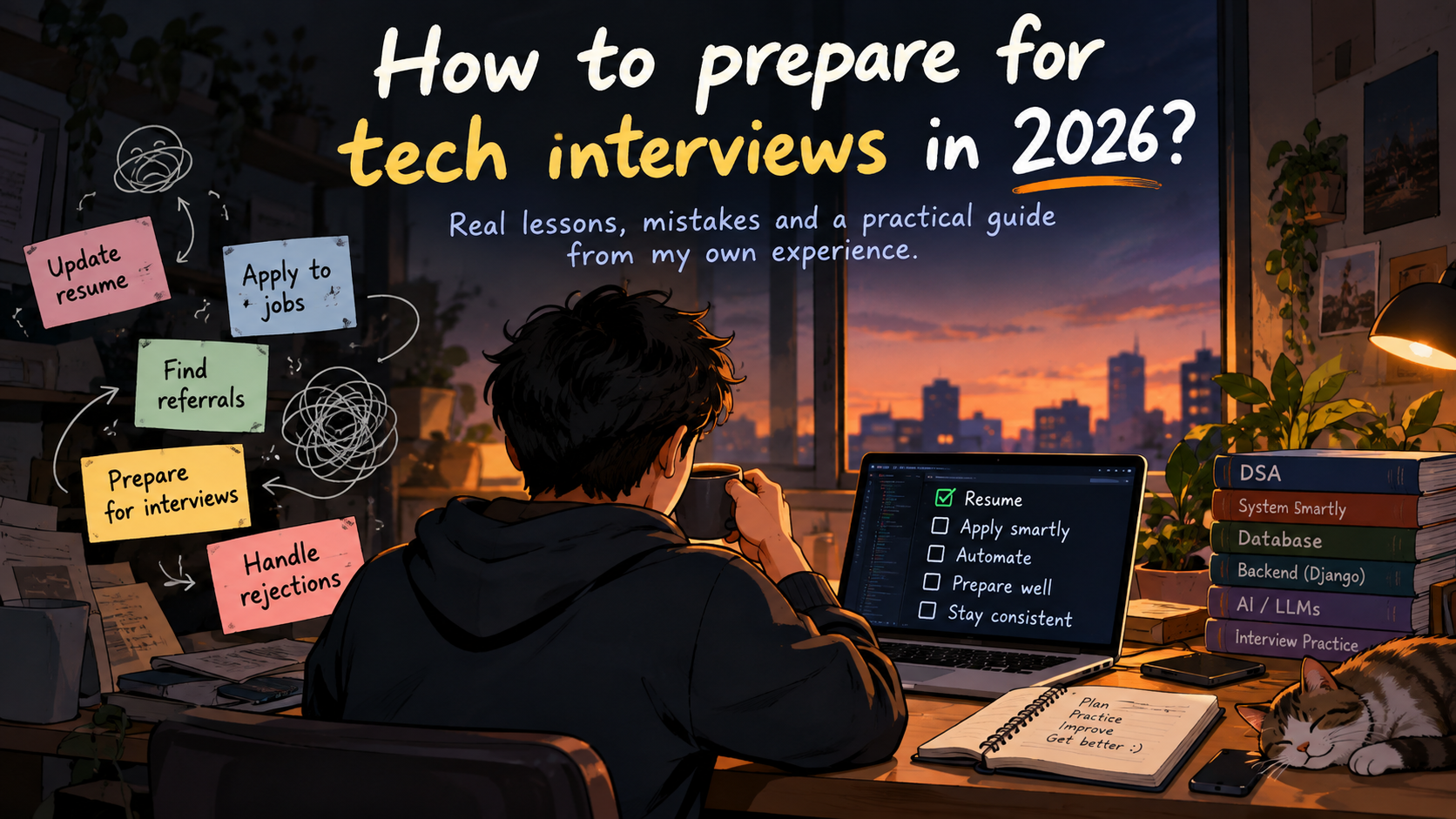
Preparing for interviews is boring, you have to prepare your resume which you haven't touched in years, update profiles, connect to ask for referrals, apply for the jobs, prepare for interviews, handle rejection!
All of these things are exhausting and take a lot of brainpower
Here's what I learned while preparing for interviews in 2026, what mistake I made, what I changed and what I learned
Invest in resume
Experience
This was the shocker for me, I used to thought my resume is already good enough. I shouldn't spend much time in it and focus on preparing for interviews bcs "that's what matters most" right ?
What I did ? used AI to generate the "perfectly professsional" resume for me and I didn't even read that myself , i just look at the format. skim thorugh few bullet points and i was like "wow, i saved so much time!".
but i couldn't be more wrong.
result : first few weeks no interview call.
I applied to soo many companies and for the first time in my career I got so few reverts.
I initially thought it's the platform then -> I used more than 6 different platforms but still same result.
I got exhausted of applying for so many companies, it even took most of my study time.
Then i just looked at my resume, this time carefully, and it was soooo bad even i wouldn't have shortlisted myself if i were the reviewer.
I wasted so many days, and opporturniteis ( because if my resume were good from the start i would have got shortlisted for few more interviews) just because I got a shortcut at the starting.
Then I spend my whole day, re-writing my resume.
This time from scratch, without using ai. I definitely used it to tweak few sentenses, brainstorming but not for generating resume.
Then i prepared the draft of my resume, shared it with all my friends, requested them to be brutually honest and review my resume.
Got it evaluated with multiple AI models, and platforms.
Took their advices, and then improved it.
I repeated this cycle for 2 more time and finally i was satisfied with my third version.
Here's my resume : Few version after the first( ai generated , quick, "much less efforts", costed me weeks later ) : link.
Final version ( manually edited, took time, "invested 1-2 days" , saved many days later ): link
It still not perfect but, way better then previous versions.
I was able to reduce the resume to single page, add impact of my work, have better formatting, emphasize on my strength.
What I learned
A resume is the first thing you should prepare before anything else.
-
Invest quality time in your resume.
- Write down everything you did: minor, major, impactful, and challenging—in full detail. Don't try to trim it down to a few lines just yet.
- Get it reviewed by AI, peers, and yourself. Pick the top 3–4 most impactful points from everything you've written.
- Trim those points down to 1–2 liners. (There are many blogs available online on how to phrase your bullet points—give them a read.)
- Generally, the format is: Accomplished [X], as measured by [Y], by doing [Z].
- Get the whole resume reviewed again by your peers, mentors, AI, and yourself.
- Does it look good? If not, repeat the steps above; otherwise, start applying.
- Are you getting callbacks? If yes, great! If not, improve your resume review process and repeat the steps above.
-
Create two or three versions of your resume.
For example, in my case, my main strength is Backend development with Django and Python, but I also have experience in PHP, AI, and Frontend development.
So, I created a few versions of my resume:
Backend-oriented: Focused only on backend-related work, omitting PHP, Frontend, and AI.
Backend + AI: Included my AI projects alongside my backend experience.
Full-stack: Included my Frontend work.
Backend + PHP: Highlighted PHP experience, which worked great for roles requiring a bit of PHP background.
I then started tailoring my application by using the version that best fit the JD.
Once you have all the details, making few tweaks becomes very easy.
Don't apply blindly
Experience
This was the second biggest mistake I made. In the beginning, I started applying blindly.
Why?
-
Because if it was a good company and I got shortlisted, I could prepare for the interview and still have a chance at the role; if I didn't apply, I was automatically out. So, something was better than nothing.
-
If it was a bad company, I would at least get to practice by interviewing.
- I had many friends during college and at the start of my career for mock interviews, but now they are busy—and mock interviews are very important.
The idea was good, and it still looks very reasonable to me.
But I was implementing it wrong.
- I started applying blindly without looking at the JD—for all companies and all roles. My goal here was quantity rather than quality.
- I applied for Backend roles, Full-Stack roles, AI roles, and roles that required Java, Node.js, or other different tech stacks.
Result? I ended up wasting a lot of time. Even though I got shortlisted, I was eliminated in the first or second rounds because my background was completely different from what was mentioned in the JD. I wasn't able to answer Frontend or AI questions at the level expected from someone with 5 years of experience in those fields.
Outcome?:
-
I did get a lot of interview calls—some of my weeks were completely packed with interviews. I was jumping from one interview to another: reading System Design, then Frontend basics, then Python, then AI, without giving enough time to any single topic.
-
Most of the jobs I applied for were at average companies that I knew I wouldn't join even if selected. But I applied anyway because, again, my goal was quantity. It gave me a false sense of "putting in effort," but produced no fruitful outcome.
Any good outcome? I learned where my weaknesses were in my primary area of strength—Backend development. I got a feel for the general questions and topics everyone was asking, plus plenty of mock interview practice.
What I Learned
- Read the JD before applying. If the role is fundamentally different from your experience or isn't something you'd realistically accept, skip it.
- Use the version of your resume that aligns most closely with the JD.
- Prioritize companies and roles that you would genuinely consider joining before others.
- Set a specific time for applying to jobs and set a timer on how much time you invest in the process. I decided to invest 1–2 hours daily—no more than that.
- Because I had a strict time limit, I was careful not to waste time. I prioritized strong companies, reached out to connections for referrals to boost my chances, and answered application questionnaires more thoughtfully instead of just relying on AI to churn out high-volume applications.
- The important part wasn't the 1–2 hours. It was putting a hard limit on application time.
now the Daily part is the most important factor here. You don't need to spend strictly 1 or 2 hours every single day—it can adapt to your schedule—but the consistency of applying daily should remain non-negotiable.
It Takes Time to Apply
This was the most boring part of job hunting: finding the opening, reading the JD, asking for a referral, sending connection requests if no one in your network was at the company, and then finally applying for the role once you got the green light.
It was taking up a huge chunk of my time. To be honest, it was thoroughly exhausting—copy-pasting the same template message to dozens of different people, keeping track of who replied and who hadn't, and following up.
I hated the process, but it was essential to increase my chances.
I used to love platforms like Instahyre because they simplified this process down to a few clicks. But because candidates started applying blindly, recruiters fought back by adding long questionnaires that end up taking even more time.
Then I came across a product called upler, and it solved most of my problems.
- It automatically reached out to employees for referrals.
- Recommending new Job opening to me after going through my resume and preference.
- The best part? It sent them an email along with LinkedIn message. Most people don't actively read LinkedIn messages unless they are a recruiter, a founder, an influencer, or job hunting themselves.
It worked like magic!!
Every day, it sent emails to 4–5 people per targeted company asking for referrals, recommended newly posted jobs across multiple platforms, followed up on email threads automatically, and sent connection requests/messages on LinkedIn in the background.
I saved alot of my time and myself, from doing all those boring stuff.
Plus, the actual impact was impressive—I received many positive responses from those automated emails, and mostly from senior engineering leaders.
-
one time I applied to a company and got a not-shortlisted email a few hours later. But because the tool sent an automated email to the Engineering Director—and he liked my profile—an interview round was scheduled the very next day!
-
In another case I forgot to even apply through the portal and simply clicked "Ask for Referral." The tool sent an email to the Tech Lead, who talked directly to HR and his manager to get my interview scheduled!!
I saw a 20–40% increase in my weekly interview calls just because of this, making the results exceptionally satisfying.
What I Learned
- Leverage automation tools: use tools like upler to remove/reduce boring stuff from the process.
- Adapt to shifting tech landscape : Stay updated with current tools. What worked today may not work after few years.
- Instahyre worked really well for me 2–3 years ago, but not so much in 2026. Uplers works great today, but its effectiveness may change two years down the line.
Preparing for the Battle
Now that the resume is ready, and we have automated or reduced the friction in applying for jobs and getting calls.
we come to the most important factor: how to prepare for the actual interview.
I did what I had been doing since the start of my career: I started solving Data Structures & Algorithms (DSA) problems and practicing System Design.
I prepared for the interview I was used to, rather than the interview I was actually going to face.
I completely skipped preparing for deep discussions on my past projects. I was confident I could easily lead that conversation because I had built those systems and worked on them for years, so I assumed I didn't need to waste time reviewing them.
However, the format of technical interviews has changed.
Almost 70–80% of companies have scaled back standalone DSA rounds and replaced them with deep Project Discussion + High-Level Design (HLD).
Being able to clearly articulate your project's business impact, failure handling, architectural trade-offs, and design evolution has become vastly more important.
(Note: If you're targeting entry-level/fresher roles, heavy DSA may still apply, but for mid-to-senior roles, this project-centric approach is the standard format most companies follow.)
DSA is still essential for big tech and FAANG-tier companies, but for many others, it isn't the main gatekeeper anymore.
So, focus on what matters most first:
- Project Discussion: Deep dive into your past architecture, metrics, and failure scenarios.
- Language Fundamentals: Internal workings of your core language (e.g., how Python works under the hood, memory management, multithreading/GIL, async execution).
- AI Basics: How to use AI tools to boost productivity, plus foundational concepts—especially if you feature AI agents or LLM projects on your resume.
- Data Structures & Algorithms: Focus on solving Easy-to-Medium problems from standard top-150 question lists.
- System Design: Master Low-Level Design (LLD) first, and then build up to High-Level Design (HLD).
Depending on your target role and experience level, exact priorities may shift slightly, but this framework provides a solid roadmap for your preparation.
Research Past Questions
Search for previously asked questions at the target company before your interview. This technique has consistently delivered high returns throughout my career.
Reviewing past interview feedback and questions gives you a clear sense of the topics a specific company prioritizes, the technical depth they expect, and how to structure your review.
What I Learned
- Research company-specific questions: Google past interview questions before every round and prepare structured answers for expected topics.- - Analyze before studying: Don't jump straight into grinding DSA or System Design blindly. Assess your core strengths, market expectations, - current industry demands, and weak spots to build a targeted preparation plan.
- Invest in structured resources: Consider paid courses if they save you time. I purchased designguru year plan because I found the quality of the content and structure really good.
The Market talk
I specifically wanted to address this topic: there is a lot of talk about company layoffs, AI replacing developers, claims that software engineering jobs are disappearing and bla bla bla...
Now let's not go too deep on how true those statements are, but the effect it put on someone looking for new job.
It almost always works against you.
It triggers a fear of falling behind, making you feel like opportunities are scarce and pushing you to settle for the first offer that comes along. It creates noise, distraction, and anxiety.
The reality is that technology constantly evolves. When calculators were introduced, people warned that mathematicians would become obsolete.
A software engineer's role extends beyond writing code quickly:
-
Navigating Trade-offs: Selecting the single most effective solution for your specific constraints out of 100 possible approaches.
-
Long-Term Ownership: Maintaining, adapting, and evolving legacy codebases as business requirements shift.
-
Problem Solving: Digging into edge cases, debugging complex distributed systems, and architecting custom solutions.
AI has undeniably transformed software development—boosting productivity, automating repetitive task work, and accelerating prototyping and brainstorming. However, it cannot replace the high-level judgment and accountability for which engineering teams are hired.
The tech landscape will continue to shift, just as it always has. Adaptability remains essential.
If you haven't engaged with AI tools or LLM primitives yet, starting now is key.
The best time to plant a tree was 20 years ago. The second best time is now.
The response to industry shifts isn't to disengage, but to adapt, keep learning, and move forward.
Thanks for reading.
Was this post useful?
Want future posts?
Subscribe